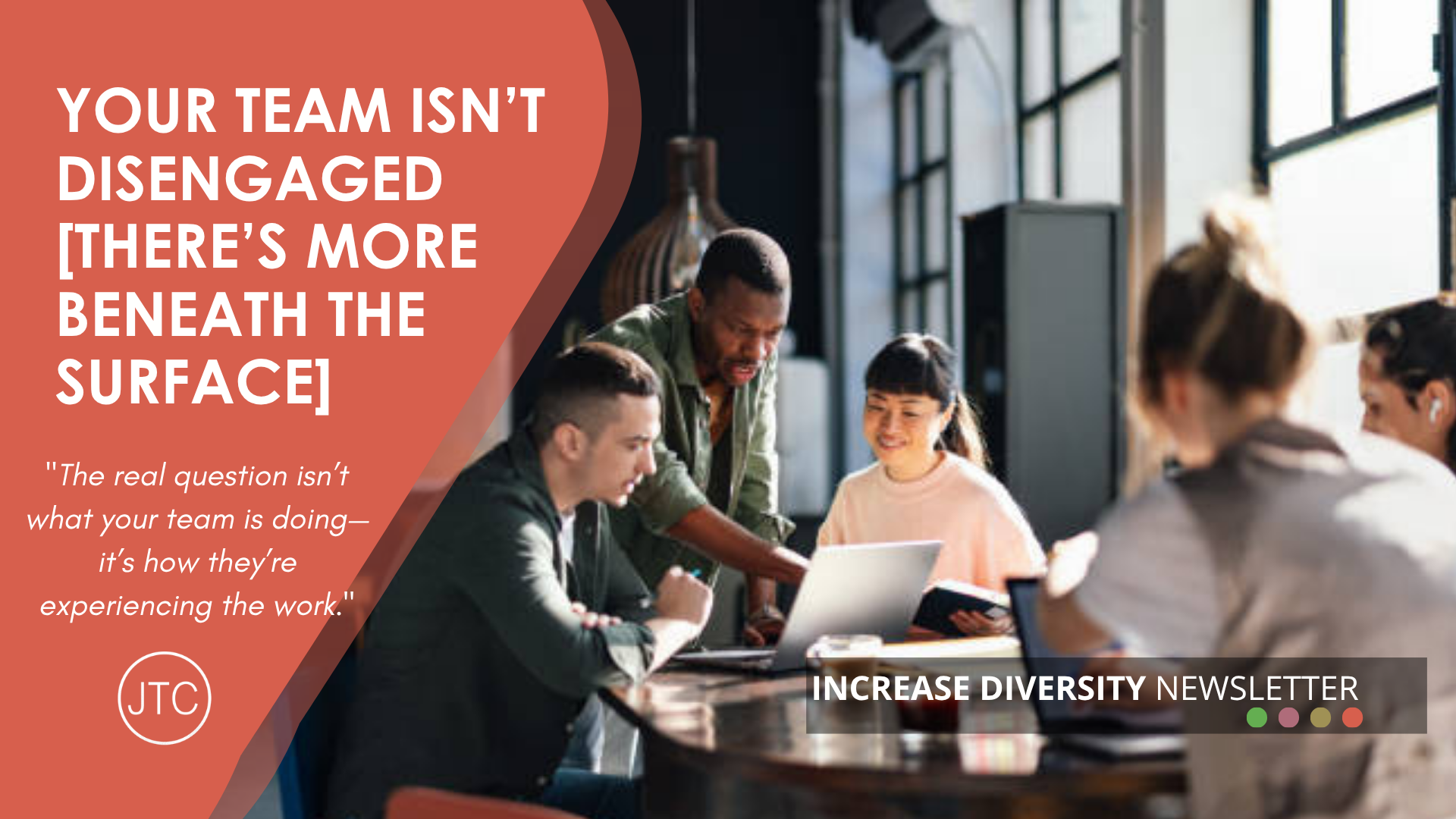
Your Team Isn’t Disengaged—There’s More Beneath the Surface
This is #IncreaseDiversity, a newsletter series + Increase Diversity Academy sharing best practices for employers who want to learn how to… well, increase diversity. To see previous editions, visit JenniferTardy.com. | IG: @IncreaseDiversity | Increase Diversity - YouTube
THE INCREASE DIVERSITY TOOLBOX | Your Essential Toolkit for Inclusive Recruitment. CLICK HERE

This Mental Health Awareness Month, I’ve been sitting with something that I think we’ve mislabeled for far too long.
We keep calling it disengagement.
But what if that’s not actually what’s happening?
There’s a term that’s been circulating recently: quiet cracking. And the more I think about it, the more it resonates. Not because it’s trendy, but because it names something many people are experiencing but not saying out loud.
This isn’t about people checking out or doing the bare minimum.
This is about people holding it together.
It’s the employee who shows up every day, completes their work, attends the meetings, responds to emails…and is still quietly overwhelmed. It’s the person who doesn’t feel safe enough to speak up, but also doesn’t feel stable enough to walk away. It’s what happens when burnout doesn’t explode. It settles in.
And there are a few things driving it.
Economic uncertainty has people holding onto jobs they may have otherwise left. You’ll hear it referred to as “job hugging” or staying not because it’s fulfilling, but because it feels necessary. That creates a kind of tension where people feel stuck, not supported.
At the same time, burnout isn’t always loud. It doesn’t always look like someone shutting down completely. Sometimes it looks like someone continuing to perform, just without energy, without connection, without a sense of sustainability.
And then there’s leadership.
More and more, I’m noticing a shift toward self-preservation. Leaders trying to hold their own roles together, protect their own outcomes, manage their own pressure. And while that may be understandable, it creates a gap.
Because when leadership becomes about survival, teams feel it.
And that’s where I think we have to pause and ask a better question:
How does my team actually experience me?
Not how we intend to lead.
Not how we believe we’re showing up.
But how it feels to work with us, day to day.
Because experience is what shapes behavior.
And this is where the DEI conversation has to deepen.
Bias doesn’t just show up in hiring. It shows up in how we interpret behavior. Who we extend grace to and who we label as underperforming. Who we assume is “going through something” and who we assume just isn’t meeting expectations.
It shows up in who feels safe enough to say, “I’m overwhelmed,” and who stays silent because they’ve learned that vulnerability may be met with consequence.
When we don’t pay attention to those patterns, we risk misreading what’s actually happening on our teams.
We call it disengagement.
We call it lack of motivation.
We call it performance issues.
But what if it’s something else?
What if it’s people navigating environments where they don’t feel fully supported, fully seen, or fully safe to be honest about what they’re experiencing?
That’s not a people problem.
That’s a system problem.
And that’s where equity comes in.
Equity is not just about who we hire. It’s about the environments we create once people are there. It’s about designing workplaces where people don’t have to quietly carry stress, uncertainty, or pressure on their own.
It’s about building systems where performance and experience are not in competition, but are understood to be deeply connected.
Because you cannot talk about performance without talking about experience.
And human-centered leadership is not soft. It’s operational.
It determines retention.
It shapes engagement.
It influences outcomes in ways we often try to measure after the fact.
So as we move through this month, I think the opportunity is simple, but not easy.
Pay attention differently.
Not just to what your team is producing, but to how they’re experiencing the work.
Because if we get that part right, everything else has a much better chance of following.