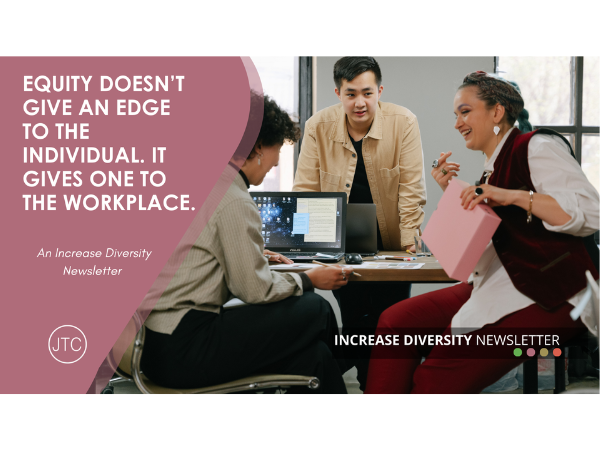
Equity Doesn’t Give an Edge to the Individual
This is #IncreaseDiversity, a weekly newsletter series + Increase Diversity Toolbox sharing best practices for employers who want to learn how to… well, increase diversity. To see previous editions, visit JenniferTardy.com. | IG: @IncreaseDiversity | Increase Diversity - YouTube
THE INCREASE DIVERSITY ACADEMY | Your Essential Academy for Increasing Diversity and Retention. CLICK HERE

Let’s rethink what we think we know about equity.
Despite what some may believe, equity isn’t about giving one group an unfair edge. It’s not about making exceptions. It’s not about handouts, charity, or reverse discrimination.
It’s about naming and removing the barriers that never should have been there in the first place.
When workplaces talk about diversity and equity, there’s often a knee-jerk reaction rooted in fear: “Are we lowering the bar?” or “What about people who’ve earned their place?”
Here’s the truth: we’re not lowering the bar—we’re finally acknowledging who’s never had a fair shot at the bar to begin with.
Bias doesn’t always look like blatant discrimination. Sometimes it’s an algorithm that filters out names it doesn’t recognize. Sometimes it’s a resume gap that tells you nothing about someone’s capacity but everything about how our systems fail caregivers, returning citizens, or people managing chronic health issues. Sometimes it’s a requirement that was never really necessary in the first place—but conveniently excluded an entire group of people.
When we talk about equity, we’re not widening the doorway. We’re clearing the path to the doorway.
Because the door has always technically been open. But let’s be honest—there have been gates, traps, detours, and doormen guarding access. There are people who should have been inside long ago, still sitting outside—overlooked, underappreciated, and underutilized.
And the most infuriating part? They’re often the most qualified for the job.
That’s what makes equity so powerful. It’s not about giving an individual an advantage—it’s about giving the organization the advantage of finally seeing, hiring, and retaining talent that’s been hidden in plain sight. Equity helps companies operate closer to what they claim they’re doing already: hiring based on merit. Because you can’t practice merit-based hiring if bias is standing in the way of identifying merit in the first place.
Equity removes the biased checkpoints, overlooked landmines, and structural blocks so that merit can actually be seen.
And let’s go one step further.
One day, our children—and their children—are going to look back and ask us:
“What was wrong with y’all?”
They’ll wonder why so many workplaces were willing to defend outdated systems rather than fix them. They’ll be shocked that there were decades where job candidates were passed over because of their name, their zip code, or their hair. Just like we look back now and ask what our grandparents were thinking—about segregated water fountains, women needing their husband’s signature to open a bank account, or job ads that openly excluded entire groups.
History always makes bias look more obvious in hindsight. But what’s obvious to the next generation should be addressed in ours.
Now, let’s talk about language.
Some people prefer to use the word “fairness” instead of equity. It sounds softer. More agreeable. But fairness is subjective—it shifts based on the eye of the beholder. What feels fair to one person might feel threatening to another if they’ve never been forced to notice the imbalance.
Equity is different.
Equity says: we don’t start in the same place, so let’s not pretend we do.
It says: the fix isn’t favor—it’s a correction. A recalibration.
It says: the problem was never who got hired. The problem was how we decided who was allowed in.
That’s what The Equity Edge is all about.
It’s not a handout.
It’s a tool for every organization ready to sharpen its systems, align its practices with its values, and finally remove the barriers keeping talent out.
Because equity doesn’t give an edge to the individual.
It gives an edge to the workplace that chooses to see them.