
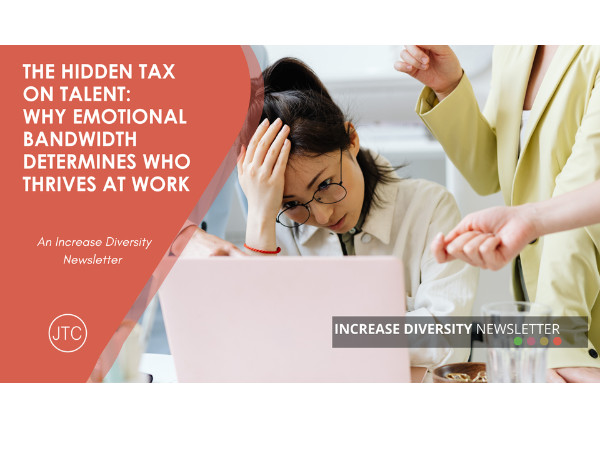
The Hidden Tax on Talent: Why Emotional Bandwidth Determines Who Thrives at Wor
This is #IncreaseDiversity, a weekly newsletter series + Increase Diversity Toolbox sharing best practices for employers who want to learn how to… well, increase diversity. To see previous editions, visit JenniferTardy.com. | IG: @IncreaseDiversity | Increase Diversity - YouTube
Jenn Tardy News + Events
POUR INTO HER | A Sweet Life Session for the Woman Who Deserves More Ease, More Care, and More Support. January 8, 2026, 7 pm EST. This is your invitation to exhale. CLICK HERE
THE INCREASE DIVERSITY ACADEMY | Your Essential Academy for Increasing Diversity and Retention. CLICK HERE

Every January, workplaces rush to set new goals, new hiring plans, new expectations, and new standards of excellence.
But here’s what I want us to walk into this year understanding:
Talent isn’t the differentiator.
Emotional bandwidth is.
Emotional bandwidth is the invisible capacity a person has to access the workplace, navigate its demands, and still function with clarity, consistency, and creativity. And while every person brings talent to the table, we don’t all bring the same bandwidth.
That difference shows up everywhere in the employee experience. And for many, it becomes a hidden tax on their ability to thrive.
The Hidden Tax Nobody Talks About
Emotional bandwidth is impacted by:
the stress you wake up with
the caregiving load you carry
your ability to rest
personal and financial instability
untreated trauma
lack of support systems
health challenges or burnout
the mental energy required to “perform” identity in certain workplaces
This tax is real.
But because it’s invisible, organizations rarely factor it in.
Instead, we reward:
the people with energy left over
the people who can take on “just one more thing”
the people who always appear polished and prepared
the people whose home lives and mental health aren’t on fire
And we call that “high potential.”
But let’s be clear:
We’re not measuring talent.
We’re measuring bandwidth.
This Is the Heart of Equity Work
In The Equity Edge, I wrote:
“Systems can put a person at an advantage or disadvantage based on two factors: their ability to access the system and their ability to navigate the system.”
Emotional bandwidth is directly tied to both.
Because if you’re exhausted before you even log in…
If you’re caring for aging parents or young children with no support…
If you’re managing chronic stress or trauma triggers…
If you’re working two jobs…
If you’re one unexpected bill away from crisis…
If you’re doing everything alone…
Your bandwidth is taxed just to reach the starting line.
That’s not lack of commitment.
That’s not lack of responsibility.
That’s life—and it matters.
Workplaces that fail to see this end up perpetuating inequity inside their own walls.
Where Bandwidth Bias Shows Up at Work
Once you see bandwidth bias, you can’t unsee it. It shows up in:
Hiring: People equate “high energy” with “high ability.” Candidates navigating heavy life loads get misinterpreted as less committed or less prepared.
Promotions: We reward employees who can say “yes” the fastest—people who have the least outside-of-work obligations.
Performance Reviews: We count responsiveness, availability, and composure as measures of professionalism…even though those things often reflect capacity, not capability.
Retention: Employees leave not because they lack skill, but because the system drains the little bandwidth they have left.
All of this is equity work.
And all of it is correctable.
Where My Three Worlds Intersect
This is one of those topics where all parts of my work collide.
From Jennifer Tardy Consulting (Hiring + Retention + Equity)
I see bias operate most strongly around the behaviors we equate with readiness:
“shows up polished”
“can do more”
“keeps a positive attitude under pressure”
“steps up without being asked”
These aren’t personality traits—they’re bandwidth indicators.
From EchoMom™ (Home Capacity + Delegation)
Women in my EchoMom™ community often share the same revelation:
Their talent didn’t change—only their bandwidth did.
With support, they rise.
Without support, they grind.
Talent stays constant.
Capacity does not.
From PWP Health (Behavioral Health + Stress Load)
Working in clinical operations has taught me that chronic stress, trauma, and constant survival mode physiologically reduce a person’s cognitive and emotional capacity.
So when workplaces punish that, they’re not evaluating performance—
they’re evaluating who has the privilege of more bandwidth.
What This Means for Recruiters, Leaders, DEI Practitioners, and Job Seekers
For Recruiters: Stop equating "high bandwidth today" with "high talent long-term." Shift interviews to measure skill, not stamina.
For Leaders: Ask a different question this year: “Is this a performance issue, or a bandwidth issue?” You’ll be surprised by how often it’s bandwidth.
For DEI Practitioners: Audit your systems for bandwidth bias: meeting norms, workload expectations, “face time” culture, response-time expectations, and promotion criteria. Bias lives in the bandwidth gap.
For Job Seekers and Employees: If you’ve struggled to show up fully, please hear this: Your bandwidth is not a flaw. It is simply data about your capacity, not your capability. Nothing about your talent or potential is diminished because your plate has been too full.
The Equity Edge for 2025
As we step into a new year, I hope workplaces shift from asking:
“Why can’t people keep up?”
to asking:
“Why did we build a system that requires this much bandwidth to begin with?”
Equity is about redesigning that system.
We don’t need people who can run faster.
We need workplaces that don’t exhaust people in the first place.
That is the hidden tax on talent.
And that is your 2025 Equity Edge.